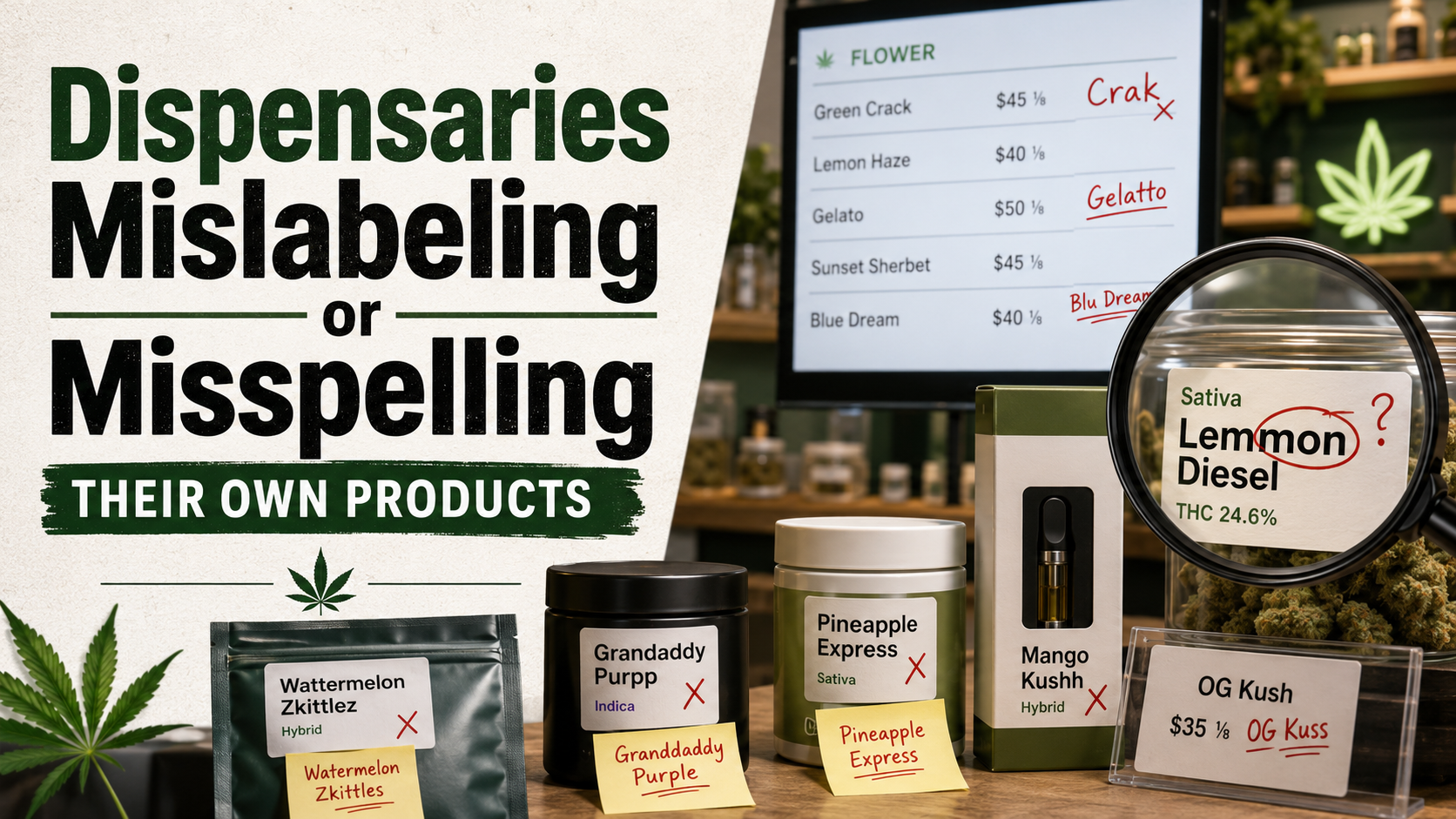
Dispensaries Mislabeling or Misspelling Their Own Products Is Becoming a Bigger Problem Than It Looks
There is a difference between making a typo and not knowing what the hell you are selling.
I have spent a ridiculous amount of time going through dispensary menus while building product-comparison and normalization systems, and one thing has become impossible to ignore:
A lot of dispensaries have absolutely terrible product data.
Names are misspelled. Weights don't match. Pack counts don't match. Strains are categorized incorrectly. Products use stock photographs that may have absolutely nothing to do with the product being sold.
And sometimes the information on the same product page contradicts itself.
This isn't me playing grammar police because somebody forgot an apostrophe.
These are products consumers are spending real money on.
If you're charging legal-market cannabis prices, the bare minimum should be knowing what product you're selling.
Some of These Aren't Even Small Mistakes
Here's a perfect example from actual dispensary data.
One edible listing was titled:
“Peppermint Mints | 10pk - 100THC”
Okay. Ten-pack.
Except the URL slug described it as:
20pk-100mg
Now it's a twenty-pack.
Then the quantity field said:
16
So apparently we have a Schrödinger's edible package that contains 10, 16 and 20 pieces simultaneously.
The total THC was listed as 100mg, while the product image wasn't even an image of the actual product. It was a generic file named:
default-edible.png
That is not a tiny cosmetic mistake. Those are multiple pieces of structured product information contradicting each other on the same listing.
Then There Are the Products That Apparently Can't Decide What Kind of Cannabis They Are
This one bothers me even more.
Indica, Hybrid and Sativa may not tell you everything about how a product will affect you, but consumers absolutely use those categories when shopping.
If somebody specifically wants an Indica and you tell them something is an Indica, that information should at least agree with your own product description.
One Nanticoke listing for:
“Lilac Diesel 1 Gram Infused Pre-roll”
had the structured strain field listed as:
Indica
while the description on the same listing said:
Strain Type: Hybrid
So which one is it?
The menu is literally disagreeing with itself.
I've seen similar classification drift elsewhere.
A product such as Miami Mami was structured as Indica Dominant, while its description called it an Indica-Hybrid.
Sour Apple was structured as Sativa, while its description described it as a Sativa-dominant hybrid.
Orange Creampop was structured as Sativa Dominant, while the description got even more specific and called it a 70% Sativa / 30% Indica hybrid.
Those distinctions might seem small to whoever is entering the menu data.
They're not small to the person actually buying it.
Calling a hybrid an Indica is inaccurate.
Calling an Indica-dominant hybrid a straight Indica is inaccurate.
And taking something consumers understand as an Indica and somehow getting all the way over to Sativa is even worse.
At that point you're not organizing inventory.
You're giving the customer incorrect information.
You Should Probably Spell the Product Name Correctly Too
This sounds obvious.
Apparently it isn't.
I've seen product and strain names drift all over the place:
Red Headed Stranger → Redheaded Stranger
Biscotti Pancake → Biscotti Pancakes
Lilac Diesel → Liliac Diesel
Blue Razz → Blue Raspberry
and one of my favorites:
Plant of the Grapes → Planet of the Grapes
Some of those may eventually turn out to be legitimate aliases.
Some absolutely will not.
That's why product normalization is such a pain in the ass.
A computer looking at two menus has to determine whether those are the same product, two different products, a dispensary typo, a manufacturer variation or an actual separate SKU.
And sometimes the typo is painfully obvious.
I've encountered a comparison listing for:
“Nanticoke | Duban Poison | Single Preroll .5G (Sativa)”
I'm going to go out on a limb here and assume the legendary strain didn't suddenly become Duban Poison.
Humans can usually look at that and say, "Yeah, somebody screwed up."
A comparison engine can't safely make that assumption.
Because once automated systems start guessing, one bad typo can result in two completely different products being merged together.
Weight and Pack-Size Data Isn't Much Better
Nanticoke listings provided another good example.
Products appeared with descriptions such as:
Pineapple Runtz 5 Pack .7 Gram
which corresponds to 3.5 grams total.
Other products such as Pluto appeared as both:
5-pack × .5g = 2.5g
and
5-pack × .7g = 3.5g
Jack Herer showed the same type of variation.
Those might actually be legitimate separate configurations.
That's precisely why the menu needs to identify them correctly.
If the product name, weight, pack count and structured data don't agree, it becomes incredibly easy for a comparison system — or a human customer — to think two products are identical when they aren't.
And Can We Talk About Stock Images?
I understand why dispensaries use stock images.
Seriously.
Menus contain thousands of products. Products change constantly. Packaging changes. Photographing every new jar, pouch, cartridge and preroll package takes time.
Using a stock photograph isn't automatically dishonest.
But it needs to be clearly treated like a stock photograph.
The problem starts when a generic image becomes the visual representation of a specific product and the customer has no idea that the thing they're looking at may not resemble what they are about to receive.
In the data I've reviewed, multiple distinct Nanticoke products used the same generic image file, including flower-stock-11-v1.jpg.
That's not an image of that individual product.
That's basically the cannabis equivalent of putting a picture on a restaurant menu and adding "food may not actually look anything like this" underneath it.
Again, I understand why it happens.
But consumers deserve to know.
If it's a stock image, label it STOCK IMAGE.
Problem solved.
Manufacturers Aren't Completely Innocent Here Either
Dispensaries aren't creating every problem themselves.
Manufacturers create another layer of insanity with product naming.
Cannabis has always played games with recognizable names, candy names, food names, famous strain names and wording that gets just close enough to something consumers already recognize.
In the product data I've worked through, names have included things like:
Hella Jelly — also known as “Jelly Rancher”
and
Orange Creamsicle BX3
along with products such as Granny Candy, Orange Creampop and Sour Apple.
Sometimes the wording is intentionally unusual.
Sometimes spelling is slightly altered.
Sometimes a product name clearly resembles terminology consumers already associate with another product, candy, brand or strain.
And then the dispensary gets that already-weird name and changes it again.
Now imagine trying to determine whether:
Jelly Rancher
Jolly Rancher
Hella Jelly
and some misspelled variation entered by a dispensary employee are four products or one.
That manufacturer-to-distributor-to-dispensary chain creates multiple opportunities for the information to mutate before the customer ever sees it.
Manufacturers need to take responsibility for creating clean, standardized product identities too.
Every product should have a canonical manufacturer name, product name, size, form, strain, package configuration and identifier that retailers can import without somebody manually reinventing the title.
Because right now there is way too much telephone-game bullshit happening between the manufacturer and the dispensary menu.
This Will Get Worse as the Industry Gets Bigger
This is the part I think the cannabis industry needs to understand now rather than five years from now.
Bad data compounds.
If Store A calls something Lilac Diesel, Store B calls it Liliac Diesel, Store C lists it as an Indica, Store D lists it as a Hybrid and Store E uploads a completely unrelated stock photograph, those errors start spreading.
Menu aggregators ingest them.
Search engines index them.
AI systems ingest them.
Comparison engines attempt to match them.
Consumers repeat them.
Eventually nobody knows which piece of information originally came from the manufacturer and which one came from somebody entering products into a dispensary POS system at 4:55 on a Friday afternoon.
Fixing it later becomes dramatically harder.
And based on what consumers are paying for legal cannabis, expecting accurate product information is not asking too much.
You can't charge premium prices while maintaining flea-market-quality product data.
That standard will only get worse if businesses allow it to become normal now.
Cannabis is still a young regulated industry.
This is exactly when standards should be getting established.
Not after ten million badly structured product listings are already floating around the internet.
The Solution Isn't Complicated
Manufacturers need standardized canonical product data.
Dispensaries should import that information instead of rewriting it.
Retailers should clearly identify stock photographs.
Strain classification should agree across the title, description and structured product fields.
Weights and pack counts should mathematically make sense.
And somebody should probably spell-check the product name before clicking Publish.
Crazy concept.
The cannabis industry wants to be treated like a legitimate mature retail industry.
Good.
Then operate like one.
Because if you're selling me a $40, $50 or $60 product, I shouldn't need a forensic data pipeline to figure out what the hell you're actually selling.
And Then There's Metrc — The System That's Supposed to Be Tracking All of This
There is another company that doesn't get to quietly stand in the background while everybody points fingers at dispensaries and manufacturers:
Metrc.
If you're going to position yourself as the backbone of cannabis traceability, then traceability needs to mean more than knowing that Package #928374 moved from Building A to Building B.
The data attached to the product matters too.
New York now requires all licensed cannabis businesses to use the state's seed-to-sale tracking system. Metrc currently advertises 30 regulatory contracts across the country. So we're not talking about some little optional inventory plugin a dispensary downloaded from the App Store. This company sits directly inside the regulatory infrastructure of a huge portion of the American cannabis industry.
And somehow we're still dealing with products where the strain type contradicts the description, weights don't match, quantities don't match, product identities drift between businesses and nobody appears to have built a giant flashing red button that says:
“Hey, this information doesn't make any fucking sense.”
That's a problem.
Especially because Metrc has figured out the transaction part just fine.
In New York, a Plant UID costs $0.10.
A Package UID costs $0.10.
And now an individual Retail Item UID costs another $0.10, meaning individual finished retail products receive their own identifiers. The New York Office of Cannabis Management confirms those charges as part of the current system.
Call it whatever corporate term you want.
From the operator's perspective, that's basically a regulatory microtransaction.
Ten cents.
Ten cents.
Ten cents.
Every identifier.
Every package.
Every individual retail item where required.
Vertically integrated businesses can encounter those costs at multiple stages of the same product's life. The Cannabis Association of New York has publicly argued that the structure can push the effective UID cost on some products from ten cents to more than forty cents as they move through cultivation, processing and distribution. That organization has gone so far as to call New York's exclusive-tag arrangement a “state-mandated monopoly.”
The Cannabis Farmers Alliance has raised essentially the same complaint, describing the current seed-to-sale situation as a “functional monopoly” because licensees cannot negotiate the tag price or choose a competing tracking provider inside the state-mandated system.
So yes, I'm going to expect something in return.
If the cannabis industry is going to be forced into a centralized regulatory data system and businesses are going to be charged repeatedly to identify the products moving through it, then data quality should be one of the primary benefits of that system.
Metrc should be helping establish canonical product identities.
Manufacturer.
Exact product name.
Exact SKU.
Strain.
Cannabis type.
Package configuration.
Net weight.
Unit quantity.
Potency.
Form.
Lot and batch relationships.
Those fields should travel with the product instead of being rewritten six different ways by six different dispensaries.
And when somebody tries to change Lilac Diesel into Liliac Diesel, classify a documented Hybrid as a Sativa, enter a 10-pack as a 20-pack or attach a weight that mathematically doesn't match the package configuration, the regulatory system should be capable of flagging that discrepancy.
Otherwise what exactly are we accomplishing?
We have created an extraordinarily detailed chain-of-custody system capable of assigning unique identifiers to individual products while apparently accepting that the human-readable information attached to those products can still be complete bullshit.
That's backwards.
I'm not suggesting Metrc personally types every dispensary menu. They obviously don't.
Manufacturers create data.
Distributors transmit data.
Dispensaries publish data.
POS systems transform data.
Metrc tracks regulatory data.
Everybody in that chain owns part of the problem.
But when one company becomes embedded into state-mandated infrastructure at this scale, it inherits responsibility too.
You don't get to become the industry's mandatory data backbone and then shrug when the data has scoliosis.
And this matters even more because consolidation is already happening around cannabis compliance technology. Metrc currently reports 30 regulatory contracts, and in 2025 it announced a strategic partnership involving BioTrack's government-facing operations. That doesn't mean Metrc literally controls every cannabis tracking system in America, but pretending there isn't significant concentration in this market would be ridiculous.
If regulators are going to hand private companies this much influence over mandatory compliance infrastructure, regulators should demand something better than:
“Yep, we successfully tracked the incorrectly named product.”
Great.
Maybe next we could accurately identify what the fucking product is.